| An In-Depth look at fishing wingdams... "Up at the Crack of Dawn!" |
|
Jarrad Fluekiger In-depthangling.com Pro Staff Mississippi River Forum Co-authored & edited by J. Holst |
|
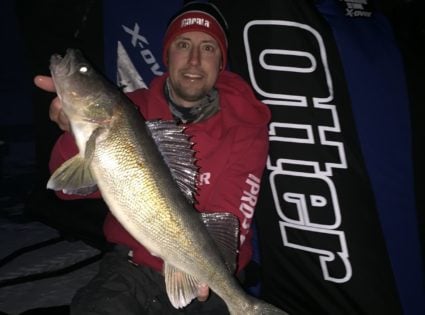
Shown below-right: Terry Fluekiger with a foggy morning walleye taken from one of the author's favorite early season wingdams
It took me a while to figure out the "what and where" of these places Gramps was fishing. We would jump from one side of the channel to the other. I figured it out when I got to be a few years older... we were fishing wingdams. Man did we ever catch the walleyes and bass, along with tons of panfish and rough fish. The older I got the more I wanted to understand these structures and why grandpa always fished them, or more importantly, why he fished some and never fished others. What are wingdams? Wingdams are man made structures that jut out from the shorelines of a river towards the center of the main channel. These structures help force the flow of the river into the main channel to keep the river deep enough at its center to allow for barge traffic. Wingdams also help stop soil erosion by forcing water away from islands, sandbars and other structures. Most wingdams are made of rock but often end up partially or completely covered with sand and submerged trees. Wingdams come in many shapes and sizes and all are definitely NOT created equal. Some dams seem to always hold fish while others that look nearly the same are nearly always devoid of life. Studying the locational differences, the differences in position on the river, the construction of an individual dam vs others nearby and the way current plays across the surface and top of a dam in a way that makes for suitable habitat for fish will make one a better wingdam fisherman. When to study wingdams? The best way to visually study the actual physical characteristics of a wingdams is to do so early in the winter or early spring when water levels are at their lowest and water clarity is at its best for the season. Water clarity at this time of year will allow an angler to look at the shallowest portion of the wingdam and see the individual rocks along the top and a portion of the front face of the dam. If it is cold out (freezing temps) ice forming on the rocks that stick out above the water will give an angler an easy visual of the high spots. Knowing that will tell you there is a low spot on each side. When the water levels are back up these low spots should be a great area to anchor above or troll through. The best way to remember those "spots on the spot" is by taking pictures so that in the following months once the waters have risen and hidden these areas from view, one can look back to the pictures of those particular pieces of structure. Another critical piece of the puzzle to becoming a proficient wingdam fisherman is to learn to judge the amount of current going over the top of a wingdam and if the appearance indicates tolerable current conditions. Sure, an angler can fish all the wingdams in a couple mile stretch of the river in a day but wouldn't it be much easier to build a "feel" for what is or is not a likely fish holding wingdam simply by assessing at a glance the amount of current present on a dam? This skill, this snap judgement of the state of the conditions on a particular wingdam, based on the appearance of the current flowing over the dam comes through time spent on the water and LOTS of it. To begin building this skill, pay particular attention to the velocity and appearance of the water in the areas on dams that you are catching fish. What you will find is that fish inhabit a very small portion of any given dam and since current velocity tends to increase as you move out from shore towards the tip of the wingdam, one can reasonably expect that most wingdams will have at least one small area that has favorable current conditions. Being able to spot these areas at a glance saves time and focuses an anglers efforts on high percentage areas. Which wingdams to start on? It really depends on a lot of factors. River conditions; is it high or low? The time of year; is it spring, winter, summer or fall? Spring Shown below-right: Wingdams located near a backwater off the main channel can be an early season hot spot!
Presentation Shown below-left: A bell sinker below a 3-way swivel is a deadly early season technique when fishing livebait
Late spring Now it is getting into March and April. Water temps and flows are rising, and baitfish start piling up out of high flow areas. Walleyes still have to find food so finding wingdams with less current on them will be your go to spots. I like fishing wingdams that are in a series along a shoreline spread out over a short distance. Each upstream wingdam will slow the current for the next one downstream. The last wingdam in the series should be a sure bet to yield some quality walleyes in high water conditions; during periods of lower water levels wingdams upstream in this series of dams will hold the most fish. The faster the current the closer you will want to be to the shore. Wingdams located on the INSIDE of bends in the river will have less current on them than wingdams located in OUTSIDE turns at the same water levels. This fact makes wingdams on the inside turns particularly attractive during period of high water. At this time of year, with the water levels running high, walleyes will tend to spawn in low current areas like backwaters, small side lakes, stream/rivers and bays. Once spawning is done those wingdams in the immediate vicinity of these spawning are that are able to provide shelter from high current as well as provide feeding opportunities will be the one you will want to target. May-September The bite is still in great shape except now we have to change a few things to stay consistent. Walleyes are starting to spread out over the entire river system so covering a lot of ground and targeting active fish will put more fish in our boats. Cranking for eyes should be in full swing. Finding funneling areas is a must. I can think of a couple areas that consist of lakes or bays that only have a few outlets from these off-channel areas to the main river. These spots should be a great starting spot. The wingdams next to them even better. Trolling crankbaits can be a very fast and efficient way to locate walleyes around wingdams and throwing deep diving crank baits from an anchored position to the "spot on the spot" on a dam is often the ticket once fish have been located or if the trolling bite dies off. When casting a deep diving crankbait to a wingdam, I like to throw it on top of the wingdam and slowly reel it back to me, frequently ticking the rock of the dam. When the line goes slack or the crankbait stops running as hard or as frantic as it was earlier in the retrieve, this is an indication that you have worked your crankbait down into an area in front of the dam where the current is slack or moving much more slowly than the current nearby. This is the spot to target! Walleyes will use this spot to rest out of the current while they wait for a potential meal. Live bait rigging is another good presentation this time of year. There are a couple ways I like to live bait rig a wingdam. One way is Dubuque rigging and the other is the old fashion egg sinker rig, either fished from an anchored position or from a boat hovering above the sweet spot on a wingdam while the position is being maintained with an electric trolling motor or small gas kicker. The best way to anchor is to position approximately 50’ above the current line or boil line located over the top of the wingdam. 8-10’ upstream from this boil line is the start of the base of the wingdam. In front of the base is the scour hole and you will want your bait in that scour hole as much as possible. When the water hits the face of the wingdam a back current is caused making a perfect spot for a walleye to rest and feed and this area should receive the majority of your attention. On days that walleyes seem finicky the Dubuque rig and control rigging the face on the wingdam may make all the difference. This way one can cover all depths of the wingdam and be able to use different presentations. A Dubuque rig is rigged up on a three way and differs from a normal 3-way rig in that a jig is used for the needed weight to maintain bottom contact instead of a bell sinker. Doing so provides an angler with an additional bait in the water. (Note * This rig is only legal on border waters. Check your local and state regulations.) One side of the three way is usually rigged with a plastic body or bucktail on a ¼ -3/4 jig, on a 6-12” dropper. I use ringworm and 5" K-Grubs from B-Fish-N Tackle for most applications. On the other leader that averages 2’-4’ in length I typically fish live bait like crawlers or leeches on a small floating jighead, plain hook or combination of hook and various beads used for added attraction. Remember boat control makes all the difference with this technique. Keeping that rig in the strike zone longer will yield more walleyes. I like to use my Yamaha T-8 kicker to position my boat above the scour holes when currents are stronger otherwise my Minn Kota autopilot works well when current levels are reduced. The tips and the holes at the end of the wingdams are to be fished completely and methodically using this method. Fall Shown below-right: Fall fishing calls for larger baits like B FISH N Tackle's 5" K-Grub
These are just a few things to help you become a better wingdam fisherman. Building one's confidence on these structures will really pay off in the long run. Remember there are no wingdams that are identical and conditions are never truly the same from one season to the next. Time on the water with a close attention to details will provide you with the ability to quickly eliminate unproductive wingdams and zero in on "the spot on the spot" regardless of season or water level.
Jarraf Fluekiger In-depthangling Video Productions offers a highly informative and educational video that focuses on catching hog-sized walleye from wingdams on large plastics like the 4" ringworms and 5" K-Grubs.
For more info on this video: |